Showing posts with label Anand Patwardhan. Show all posts

30 May 2006

Stop in the Name of Man!

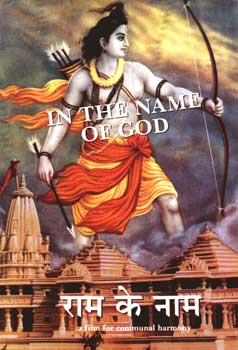
A review on Anand Patwardhan's documentary In The Name of God.

The Alliance Française presented a few documentary films by noted film-maker Anand Patwardhan. When it was announced that the first film, ”In the Name of God”, was about politics and the Babri Masjid demolition, I groaned. Politics is one topic I generally avoid like the plague. Never been interested. I am of the kind who believes that the word “politics” is derived from the following words:

Poly: Greek word for “Many”
Tick: Bloodsucking creatures

I however decided to stick on and watch the film because I had nothing better to do. What I saw for the next 75 minutes was very disturbing.

”Long ago” to 1949.
Ayodha. The birthplace of Lord Ram. A town where hindus and muslims co-existed peacefully. They respected and loved one another. The exact spot of Lord Ram’s birth had always been a mystery to one and all. A hundred temples in Ayodhya claimed to be the birth-site of Lord Ram.

Babri Masjid was a 16th century mosque built in Ayodhya by Emperor Babar. It was rumoured for many decades that the Babri Masjid was built after demolishing a Ram temple which was the exact birth-site of Lord Ram. This rumour however did not strain relationships between hindus and muslims. A temple was built near the mosque. The temple was called the “Ram Janmabhoomi Temple”. Hindus prayed at the temple and muslims prayed at the mosque. All was well.


1949.
One night, the priest of the Ram Janmabhoomi Temple, without anyone’s knowledge, moved the idols of the Ram Janmabhoomi Temple into the mosque with the assistance of a few government officials and support of a District Magistrate. The priest later claimed to have dreamt of a 4-5 year old Lord Ram beckoning him into the mosque and assumed that that was the birthplace of Lord Ram.

The next day was Friday. When the muslims went to pray at the Babri Masjid, they were surprised to find the Police there. They were denied entrance into the mosque. The Muezzin was told by the District Magistrate that things would get back to normal the next Friday.

1990.
The Muezzin still waits for that Friday.


The Vishwa Hindu Parishad (VHP), a political party digs up the Ram Janmabhoomi issue and declares that the Babri Masjid was indeed the birth-site of Lord Ram. The VHP vows to demolish the mosque and build a new Ram temple there.

This documentary film captures the birth and rapid growth of VHP’s campaign to build the Ram temple at Ayodhya by destroying the Babri Masjid. This film was filmed and released prior to the actual Babri Masjid demolition. The Babri Masjid demolition resulted in the deaths of 5000 people all over India. Communal violence.

Featuring interviews with VHP activists, the common man as well as a few important people who were directly involved in this issue, this film looks at different people and their perspective of the whole issue.

While the VHP activists’ words drip of religious intolerance, it is surprising to find that the common man talks about this issue in a very practical and logical way. Many interviews with the common man (mostly illiterate and belonging to a very low caste) reveal that he is more intelligent that the media portrays him to be. An ironworker in a village displays higher levels of intelligence than a VHP activist who is a lawyer.

The priest of the Ram Janmabhoomi Temple in 1990, Shri Laldas, is another man whose words are full of wisdom. He has a genuine concern for humanity. He feels that the whole Ram Janmabhoomi issue was resurrected by the VHP to garner votes in the next election. He says that the leaders of the VHP do not really care about the Ram temple.


-x-

''The VHP leaders tell everyone that they’d go to any length to build the Ram temple here. Have they come to this temple at least once to offer their prayers?''

-x-

Shri Laldas


(Shri Laldas was assassinated in 1992, after this documentary was released. The assailants are unknown and scot-free.)


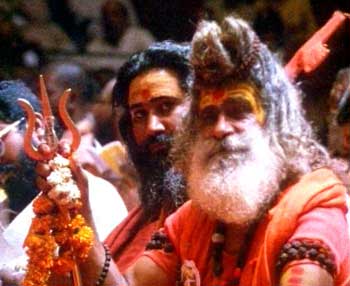
The interviewed VHP activists, on the other hand, turn out to be educated but illogical people. Most of them brandish swords and tridents. The film actually captures them first rehearsing and then loudly chanting these slogans at public meetings:

-x-

“We will use the oil of Dabur!
To burn the descendents of Babar!”

“Babri Masjid hamari hai!
Kasi, Mathura baaki hai!”
(Babri Masjid is ours, Kasi and Mathura are next!)

-x-

The film also captures the plight of muslims in Ayodhya who live every day in uncertainty and can “smell death around the corner”.

-x-

Awards won by In the Name of God:

Filmfare Award, Best Documentary, India, 1992
National Award, Best Investigative Doc. India, 1992
Ecumenical Prize, Nyon, Switzerland, 1993
Documentary Prize, Freibourg, Switzerland, 1993
Citizen’s Prize, Yamagata, Japan, 1993

-x-

In the Name of God is thought-provoking. It is very, very hard-hitting. It talks about blind faith and the alarming decline of humanity in today’s world. It is definitely not a film you’d want to watch with your family on a nice evening over biscuits and tea.

I sincerely hope this film becomes irrelevant over time.

The film ends (so does this review) with a doha by the poet Kabir:

Saints, I see the world is mad.
If I tell the truth they rush to beat me,
If I lie they trust me.
I’ve seen the pious Hindus, rule followers,
Early morning bath takers –
Killing souls, they worship rocks.
They know nothing.

I’ve seen plenty of Muslim teachers, holy men
Reading their holy books
And teaching their pupils techniques.
They know just as much.


And posturing yogis, hypocrites,
Hearts crammed with pride,
Praying to brass, to stones, reeling
With pride in their pilgrimage,
Fixing their caps and prayer beads,
Painting their brow-marks and arm-marks,
Braying their hymns and their couplets,
Reeling. They never heard of Soul.

The Hindu says Ram is the Beloved,
The Turk says Rahim,
Then they kill each other.

No one knows the secret.
They buzz their mantras from house to house,
Puffed with pride.
Their pupils drown along with their gurus.
In the end they’re very sorry.

Kabir says, listen saints:
They’re all deluded!
Whatever I say, nobody gets it.
Its so simple.

--
© Guru Smaran

Dark Side of the Epic

A review on Anand Patwardhan's documentary We Are Not Your Monkeys.

Anand Patwardhan’s We are not your Monkeys is about many things: the caste system, gender oppression and humanity.

Backdrop: The Ramayana.

Thematically, We are not your Monkeys could be broken down into two parts.

The first part is about the condition of Dalits, an untouchable caste in India, in today’s world. It talks about the dehumanization of the Dalits by the upper castes who call them “untouchables” and yet enjoy a comfortable life due to them. We see frames of Dalits doing all the dirty work like cleaning sewers, etc. to make life easier and much more livable for the upper caste people.


The second part is about the Ramayana. A dalit’s perspective that talks about caste oppression and lack of basic human rights in the Ramayana.

It starts off by telling us how Lord Ram, a foreigner, took over from the Dalits their land.

(Sanksrit literary scholars have actually found references over a take-over of a dark-skinned populace by nomadic Aryan tribes. Lord Ram belonged to the Aryan race and is hence portrayed as an outsider.)

Some excerpts:

-x-

“You portrayed our god Hanuman as a monkey.”

“You formed a monkey army to attack Lanka.”

“When you finally captured Lanka, you wanted Sita to prove her chastity to you.” (Portraying Lord Ram as a male chauvinist.)

-x-

There are also references to the Babri Masjid dispute at Ayodhya and their opposition to the issue.

-x-

“You now want a monkey army to grab Ayodhya. But this monkey army will not help you seize Ayodhya.”

-x-

The video ends thus:

-x-

We sing the song of humanity. And we will make you human as well.

-x-

“We are not your monkeys”, released in 1993, is only 5 minutes long. It is a music video. It is a song composed by Sambhaji Bhagat, Anand and the late Daya Pawar, and sung by Sambhaji Bhagar.

This perspective of the Ramayana, though very controversial, is novel and thought-provoking. It is something we haven’t heard. Though not many may agree to this perspective, it still makes one think for a long time.

The video is a must-watch. It is powerful and hard-hitting. It questions the character of one of the biggest heroes in Indian Mythology, a hero who has an “all white” character. It questions history, religion, and things we have believed in all our lives.


PS: The quotes I have mentioned above are from memory and hence may not be accurate.

--
© Guru Smaran